Showing posts with label Immigration Reform. Show all posts

Wednesday, January 1, 2014

Here We Are 2014 - What Can We Expect and Hope For?

What Will 2014 Bring?
Photo by www.chicagotribune.com

Here are some Laws That Go Into Effect

Colorado - Today in Colorado people of legal age can purchase pot, cannabis sativa, hemp, ganja, reefer, maryjane, in different brands. Acapulco Gold, Panama Red, Maui wowie, and more. Starting today, January 1, 2014, if you are 21 or older you can buy the pot not only for medical use but for recreational use. There are tight limits placed on nonresidents. Colorado residents can possess up to one ounce or grow as many as six (6) plants at a time. Some reports say that at least 20 stores will open today to sell medical and recreational marijuana and that is expected to grow to about 100 stores within 6 months. 

Photo by www.cnn.com
California -  AB 60 accomplishes something immigrant advocates have sought for years – driver’s licenses for immigrants who are in the country illegally. The California Department of Motor Vehicles will spend this year designing the licenses, which will become available by Jan. 1, 2015. SB 4 seeks to regulate hydraulic fracturing, or “fracking,” a gas-harvesting practice that involves blasting a mix of pressurized water and chemicals underground. Rules taking effect at the start of 2014 mandate groundwater monitoring, require neighbors to be notified of new wells and have energy companies publicly disclose the fracking chemicals they use. READ MORE from The Tribune

Graphic by bonzerwolf.squarespace.com

Illinois - Huffington Post came out with a list of 10 of the Most Important Laws to Take Effort Jan. 1 in Illinois rounded up some of the most important new Illinois laws of 2014. For a complete list, visit the Illinois Senate Democrats' website. Plus, of course, there's a slew of new federal laws -- including the new ban on incandescent light bulbs. Here's just one:

ANNIE, GET YOUR GUN
Earlier this year, Illinois became the final U.S. state to pass a concealed carry law and, starting this week, it will formally go into effect. Beginning Sunday, Illinois residents can apply online for a concealed carry permit on the Illinois State Police's website. State Police are required by law to approve a license, should no problems arise, within 90 days and the first licenses are expected to be issued by mid-January, ABC Chicago reports. (HB 183)

Graphic by www.statepolitics.lohudblogs.com

Minimum Wage Goes Up in 13 States

The state of Washington will remain the state with the highest minimum wage in the country with a minimum wage of $9.32 per hour. There are counties and cities that will also be raising their minimum wage like San Francisco who is raising their minimum wage to $10.74 per hour. The municipality with the record for the highest minimum wage in the country is due to a ballot measure where voters in SeaTac, Washington approved a $15.00 per hour minimum for about 6,000 airport workers. The new wage goes into effect today. It is currently being challenged in court. 

Ten states have tied their minimum wage to the inflation index which guarantees that their minimum wage will rise with the cost of living each year. Governor Jerry Brown of California signed legislation that will eventually raise their minimum wage to $10.00 by 2016, although the first increase will be to $9.00 and won't take effect until July of 2014. 

31 states rely on the federal minimum wage and don't mandate a higher one. The federal minimum wage was last raised in 2009 ending a series of increases that were signed into law by President George W. Bush. Although the federal minimum wage is not tied to a cost of living (COL) increase the Democrats in Congress and President Barack Obama say it should be. The minimum wage bill put forth by Sen. Tom Harkin (D-Iowa) and Rep. George Miller (D-Calif.) would raise the minimum wage to $10.10 per hour and tie it to inflation.

Below is a list compiled by the Employment Policies Institute of the increases taking place today:
  • Arizona: $7.80 to $7.90
  • Colorado: $7.78 to $8.00
  • Connecticut: $8.25 to $8.70
  • Florida: $7.79 to $7.93
  • Missouri: $7.35 to $7.50
  • Montana: $7.80 to $7.90
  • New Jersey: $7.25 to $8.25
  • New York: $7.25 to $8.00
  • Ohio: $7.85 to $7.95
  • Oregon: $8.95 to $9.10
  • Rhode Island: $7.75 to $8.00
  • Vermont: $8.60 to $8.73
  • Washington State: $9.19 to $9.32
  • Albuquerque, N.M.: $8.50 to $8.60
  • Bernalillo County, N.M.: $8.00 to $8.50
  • San Francisco, Calif.: $10.55 to $10.74
  • San Jose, Calif.: $10.00 to $10.15
  • SeaTac, Wash.: $9.19 to $15.00

Meme by theliberloc.com


Read more here: http://www.sanluisobispo.com/2014/01/01/2857554/californias-new-laws-what-changes.html#storylink=cpy

Read more here: http://www.sanluisobispo.com/2014/01/01/2857554/californias-new-laws-what-changes.html#storylink=cpy

 There's Much More That Needs To Be Done

There is so much more that needs to be done in 2014 following "The Least Productive Congress in the History of the United States," 113th Congress. Each member of Congress will earn a minimum of $174,000 for working about 125 days. That equates to $1,392.00 per day, or $174.00 per hour if they worked 8 hours on each of those days. In addition to, and as part of, their salary they receive employer (taxpayer) paid health insurance. The health is part of their salary. Since they have a golden plan that covers almost everything they would have to pay at $3,000/mo for the plan if it weren't paid for by their employer, the taxpayer. That would bring their annual salary to $210,000, or $1,680/day, or $210/hr. In addition to this straight salary they get much, much, more in benefits.

You would think that they would actually do something for their pay but that didn't happen in the 113th Congress. The House Republicans did make things up and legislate them to make people beleive that they were actually doing something. One of my pet peeves was the "Vitter Amendment." This was something totally fabricated, and actually never of happened. Yet they wasted time and money, in addition to going to the media and totally blowing the fabrication out of proportion. 

To refresh your memory the Vitter Amendment goes way back to when Chuck Grassley's effort to embarrass Democrats back during the Affordable Care Act debate by sponsoring an amendment to force members of congress and their staff to use the ACA exchanges. Except instead of being embarrassed, Democrats accepted the amendment. The Office of Personnel Management has interpreted this Grassley proposal as simply modifying the form that the existing benefits package takes. Instead of the government giving congressional staff free health insurance, the government will give congressional staff money to shop on the exchange. The original Vitter Amendment would have prohibited the OPM from giving staffers that money—thus forcing an across-the-board cut in congressional staff pay. The new Vitter Amendment makes the proposal less pernicious by narrowing its reach. But it's still a bizarre idea, government by trolling.

The OPM would of never allowed them to change the benefit package for the Congress and their staff. There's even a new version of the amendment. They were still playing games with this total crap in October 2013 when they proposed a new version of the amendment!

The way the "New Vitter Amendment would work is that House members, senators, the president, the vice president, and Cabinet officers would all lose their employer-provided health insurance (which will never happen, and they could never make it happen). Then they would be told to go buy health insurance on the Affordable Care Act exchanges. And the government would not be allowed to use the money it saves by no longer providing the insurance to raise salaries or to subsidize exchange purchases. In other words, all the top-ranked officials take a pay cut for no reason.

This is the kind of crap they occupy themselves with instead of passing a farm bill, passing a jobs bill, immigration reform, financial reform, infrastructure repair and replacement since 80% of our infrastructure is deemed obsolete or in need of repair or replacement, or any of the other much needed things to bring back the middle class and the economy, and lower the deficit. We have to hope that John Boehner will stand up to those groups (Heritage Action, Club for Growth, Freedom Works, and others) like he did to put the Ryan-Murray budget up for a vote. Get involved, use your power, by calling your Senators and Congressmen/women on a regular basis. Below is a link to assist you in finding and contacting your Representatives.

This all goes back to 
As an aside, including the president in the New Vitter Amendment is particularly nonsensical since the president has a staff physician provided by the White House Military Office and doesn't really need a health insurance plan per se at all.
health insurance. Not  


Thursday, December 19, 2013

Congratulations 113th Congress - You've made the Guiness Book of World Records as "The Least Productive Congress in U.S. History"

Congratulations Indeed - Obstructing Legislation, Spending Over $60M in Taxpayer Money Voting to Repeal  The Patient Protection and Affordable Care Act (Obamacare,) and Not Passing a Farm Bill, Unemployment Extension, Immigration, Minimum Wage and So Much More

Chart by www.msnbc.com

A Budget Bill was Passed, But Not Much More

Thanks to House Budget Committee Chairman Paul Ryan (R-WI) and Senate Budget Committee Chairwomen Patty Murray (D-WA) a budget bill was passed so we won't have another government shutdown for two years. It was encouraging to see House Speaker John Boehner (R-OH) stand up to outside groups like Heritage Action, Club for Growth, and Freedom Works See December 13, 2013 Get Involved for a Better America Post but, he's back, saying he won't put up any bill to raise the Minimum Wage, even a dime.

The House TeaPublicans spent over $60M on 46 votes to repeal "The Patient Protection and Affordable Care Act" aka "Obamacare." Some say the definition of "insane" is to repeatedly do the same thing over and over expecting a different outcome, well the TeaPublicans definitely fit that definition in this instant.

Meme by thejennerjahnreport.blogspot.com

 In a Think Progress article from May 15, 2013 when they were about to take the 43rd vote Think Progress said:

 To put that in perspective, they have held votes on only 281 days since taking power in January 2011. (The House and Senate have pretty light legislative loads these days, typically voting only three or four days a week.)

 That means that since 2011, Republicans have spent no less than 15 percent of their time on the House floor on repeal in some way. [...] Michael Steel, [Speaker John Boehner's spokesman], said that spending 15 percent of their time on the issue was hardly a waste for Republicans. “Given that the bill amounts to a takeover of roughly 15 percent of the American economy,” he said, “that sounds about right.”

 By some earlier estimations, Republicans in the 112th Congress wasted about 90 hours and $50 million dollars on their multiple failed efforts to get rid of the health reform law. This new Congress is shaping up to be no different. Even though Republicans have admitted they have lost on Obamacare, and are even acknowledging that their future repeal efforts will fail, they have continued to block legislative efforts to amend the health reform law in favor of stubbornly opposing it altogether.

 Now that the 113th Congress has completed 46 votes it is estimated to be over $60M of taxpayer money doing something over and over again expecting a different outcome.


Picture by www.newsofinterest.tv

Some Things That Didn't Get Done

 Annual appropriations bills are normally passed with little discussion, but not in the "least productive Congress in history." In defending his Congress House Speaker John Boehner (R-OH) said "more than half of the annual appropriations bills and the Senate hasn't passed any of them." First of all, "passing" only little more than half of the annual appropriations bills is not acceptable. Secondly, when you write absurd things into bills, no matter how much the bill might have started out sensible, it won't be passed because of what had been attached to it.

 Appropriations bills always originate in the House and they require both chambers to work on them to get them signed into law. Beyond that, the House won't take up several major bills that have cleared the Senate, including immigration reform and the Employment Non-Discrimination Act.

 The handful of key bills that have passed the House, such as re-authorization of the Violence Against Women Act and disaster relief for Hurricane Sandy victims, were accompanied by intense partisanship.


Photo by www.capitalisminstitute.org

The Farm Bill and Food Stamps

 The House also didn't give itself much time to work this month, despite not having passed a Farm Bill, an Immigration Reform Bill, the Fair Minimum Wage Act, a Jobs Bill, an extension to Unemployment, and much, much more As of Tuesday, the House is scheduled to work only seven days between now and Jan. 7, when members return for the second session of the 113th Congress. The Senate is currently scheduled to be in for most of the month. In recent months August, and December, Congress will work 9 days each month and get paid $29,000, that's more than $3,000/day, not bad, especially when they want to cut another $39B out of Food Stamps. A family eligible for food stamps, including those working full-time at places like McDonald's and Wal*Mart, were getting $1.50 per meal per person. The cut that recently took effect cut about $5B out of food stamps, that's $36 less for a family of 4 receiving $600/mo. Remembering that the $600 works out to $1.50 a meal for each person, on top of the money already taken out of food stamps the TeaPublican Congress wants to take another $39B from the program. That would be another $216 taken from that family if 4. That's the main reason a Farm Bill wasn't passed as food stamps are administered through the Dept. of Agriculture, and therefore part of the Farm Bill.


Photo of Infrastructure by wfrc.org

 Infrastructure

Our infrastructure is deteriorating at an alarming rate, bridges that we drive over everyday have already failed multiple inspections. According to Global Research www.globalresearch.ca "America's Failing Infrastructure" as of 2010 America is not even in the Top 10 in infrastructure competitiveness. Even with higher household earnings we spend more on transportation than other developing nations. Americans spend 17.6% of their household earnings, that's $8,810 per family, with an average income of $50,054/yr, with 4.8 billions hours wasted in traffic jams in 2008 to the tune of 3.9 billion gallon s of gas. 210 daily trips are taken across deficient bridges in our 102 largest cities. 1/4 of U.S. Bridges are "Functionally Obsolete" or "Structurally Deficient." including 77% of the bridges in Washington, D.C. The U.S. has fallen to 22nd for quality of port infrastructure.


Photo by www.newsofinterest.tv

Immigration

 In an article from The Hill on December 19, 2013, Time is Now for Immigration Reform it is reported that:

"Wide acknowledgement from Republican House leadership — and support among Republican constituents — shows that immigration reform is definitely not a “dead” issue, but one with great opportunity in 2014.

 Every member of the House leadership team has expressed commitment to move reform forward in 2014, and each week the number of rank and file Republicans in favor of reform grows.

 In 2013 we made great strides toward a successful 2014 for immigration. Considering that just over a year ago this issue was on the sidelines, the fact that the home stretch is in sight is no small accomplishment.
2014 stands to be that blockbuster year that finally takes reform across the finish line."

 The Latino Post asks Will Congress Pass a Reform Bill During the 2014 Election Year?  At a recent immigration reform debate held at Rio Salado College in Temple, Ariz., nationally known immigration experts and advocates weighed in on the issue. 

"I would be a crazy person to bet my house that it was gonna happen - I'm not foolish, but I also would not bet my house that it won't happen," said Tamar Jacoby, the CEO of Immigration Works USA, a federation of business groups that support reform, to the Fronteras Desk.

He continued, saying that House Republicans may be more willing to vote for immigration legislation once they know whether or not they will be challenged by another Republican in a primary during mid-term elections next year.


Meme by blog.atrinternational.com

Optimism for 2014

 This writer  likes to be optimistic, I'd like to think that Since John Boehner finally stood up to the extreme right-wing groups once, that he'll do it again. I'd like to think that the Tea Party is on it's way out, in part thanks to their stupidity of shutting down the government over repealing Obamacare, especially since they had already voted over 40 times to repeal it to n o avail. I'd like to think that the brainwashed, low-information voters will see the light and vote out the politicians (who themselves have golden healthcare plans through their employer, the government, the taxpayers,) that are telling them that their not going to extend Medicaid, at no cost to the state for three years, so they can receive healthcare. I'd like to see them approve work on our infrastructure, creating jobs. I'd like to see the war on women come to an end. I'd like to see all the Republican Governors stop passing laws to disenfranchise voters. I'd like to see all the gerrymandering stop, so that Democrats don't have to win an election in a given state by a margin of 7-1 to be victorious like in Pennsylvania. I'd like to see a comprehensive jobs bill passed. In the immediate future I'd like to see unemployment benefits extended, and minimum wage raised. I'd like to see the trend of income inequality start to turn around.

Chart by currydemocrats.org


The 2014 calendar for the House shows members will work 113 days, down from 126 days in 2013. In 2012, 107 days were scheduled. I hope that things start to turn around in 2014. There are some things that we can do. We can contact our Congressmen/women https://www.govtrack.us/, U.S. Senators through http://www.senate.gov/, and our State Senators and Assemblymen/women at http://votesmart.org/login?next=/user#.UrN4zSccNht. 

The biggest problem in our government right now is that our elections and our politicians are corrupt. This corruption was cemented into place when on January 21, 2010 the U.S. Supreme Court ruled in favor of Citizens United in Citizens United v FEC. This landmark case removed limits on how much corporations could contribute to campaigns. The amount of money spent by the ultra-rich, corporations, and Super PACS skyrocketed. An example would be that top donors from the fossil fuel industry donated over $11M in the 2012 election cycle. On October 8, 2013 the Supreme Court heard another case, yet to be decided, but will probably go the same way, 5-4, because the same people are in the Supreme Court, McCutcheon v FEC. If this case is decided for the Alabama businessman, individual aggregate limits will be removed for individuals. That means that those same top donors from the fossil fuel industry that donated $11M will be able to donate 27x that, or $312M. There is a nationwide effort for states to produce resolutions to get the U.S. Congress to pass a Constitutional Amendment to overturn Citizens United, go to United 4 The People to find what local organization you can work with toward this effort.


Sunday, December 8, 2013

Do-Nothing-Congress Has 4 Days Left - We Have Their Calendar and What's Not On It


Chart by republicanjobnation.com

Where's The Farm Bill, Immigration Bill, Jobs Bill, or Any Significant Legislation That Would Move the Country Forward?

Legislative bills that are normally passed without even a discussion were not passed because they were never even brought onto the floor of the House of Representatives for a vote. The real problem is that the Tea Party members and establishment Republicans can't seem to get anything significant done, House Speaker John Boehner has had to rely on Democratic votes to get bills passed.

A major reason for the lack of legislating, of course, rests in the divided government re-elected in 2012. That left Democrats in control of the Senate and White House, with Republicans in charge of the House.
Sarah Binder, an expert on legislative politics at the Brookings Institute, says that other factors are to blame as well, like policy disputes between members of the same party and the dwindling number of moderates willing to mediate tiffs between warring factions.

Carrie Dann,  a political reporter for NBC News states that the Senate passed comprehensive immigration reform legislation earlier this year but prospects for a vote in the House are slim. House Republicans have voted some 47 times to either repeal or somehow change the newly enacted health-care law, efforts that have been shelved in the upper chamber.

That sets the backdrop for an election year in 2014. With all 435 House seats up for re-election and 33 Senate seats at stake next November, the balance of power in Congress is very much in play. Read More: NBC Politics article about our "Do Nothing Congress" November 26, 2013

With only a handful of remaining legislative days on their calendar, this current Congress is on track to go down as one of the most unproductive in modern history. The paltry number of bills Congress has passed into law this year paints a vivid picture of just how bad the gridlock has been for lawmakers, whose single-digit approval rating illustrates that the public is hardly satisfied with their trickle of legislative activity.

According to THOMAS, the legislative tracking service, this Congress has passed just 52 public laws since it gaveled into session in January. Check the

 At this point in George W. Bush’s second term as president, for example, 113 bills had been enacted into law, according to numbers crunched by Pew Research Center’s Drew DeSilver. In the same amount of time during the 110th Congress – from January until before the Thanksgiving recess of 2007 – that number was 120.

So far this year, the president has signed legislation to specify the size of commemorative coins for the Baseball Hall of Fame, to name a subsection of IRS code after former Sen. Kay Bailey Hutchison and to honor baseball great Stan Musial with a namesake Midwestern bridge.
With the ceremonial measures excluded, according to DeSilver’s calculations, Congress has enacted just 44 “substantive” laws so far this year. That’s well below the average of about 70 substantive bills passed in the equivalent time period between 1999 and 2012.


Photo by Eric Wolfson

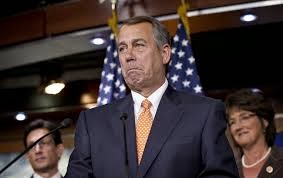
U.S. House of Representatives John Boehner (R-OH)

 Many in Washington say Boehner is to blame for his woes. Others say the fractious nature of the current Republican caucus might have undermined any speaker. Newt Gingrich, who held the post in the mid-1990s, says that Democrats’ control of the Senate and the White House has made Boehner’s job “10 times harder than mine was.” Boehner still plays a key role in Congress, but primarily by refusing to allow votes on measures supported by the Senate, like its immigration reform bill, which Democrats say would  pass if it came to the floor. In fact, in a strange twist on bipartisanship, most of the must-pass measures adopted by Congress recently have gotten through the House only when Boehner has defied the wishes of a majority of his caucus and relied on Democrats. Those votes have been widely described as a sign of weakness. If that is so, that may be evidence that the problem isn’t purely Boehner’s own. His Democratic predecessor, Nancy Pelosi, turned to Republicans seven times for votes she couldn’t get from her own side.


Paul Ryan (R) and Patty Murray (D) working on budget deal.  Photo by navytimes.com

 Obama vs. Boehner: Who Killed the Debt Deal?

In a New York Times Magazine Article in March, 2012 - Who Killed The Debt Deal?  Almost immediately after the so-called grand bargain between President Obama and the Republican speaker of the house, John Boehner, unraveled last July, the two sides quickly settled into dueling, self-serving narratives of what transpired behind closed doors. In the months that followed, some of Washington’s most connected Democrats and Republicans told me in casual conversations that they didn’t know whose story to believe, or even what, exactly, had been on the table during the negotiations. Both sides knew that if the most crucial and contested details of their deliberations became public, it would complicate relationships with some of their most important constituencies in Washington — or worse. It’s one thing for a Democratic president to embrace painful cuts in Medicare and Social Security benefits, or for a Republican speaker to contemplate raising taxes, if they can ultimately claim that they’ve joined together to make the hard decisions necessary for the country; it’s quite another thing to shatter the trust of your most ideological allies and come away with nothing to show for it. Obama and Boehner have clung to their separate realities not just because it’s useful to blame each other for the political dysfunction in Washington, but because neither wants to talk about just how far he was willing to go.


Photo by jobsanger.blogspot.com

December is for Deadline on Budget Deal:


December 13, 2013 is when House Budget Committee Chairman Paul Ryan (R) and Senate Budget Committee Chair Patty Murray (D) are supposed to produce the compromise conference report on the budget negotiations; By the way, congressional appropriators are very itchy to get at least a topline number from Ryan-Murray to find out if Sequester 2 is really going to kick in.

Democrats are resisting a proposal to increase the amount federal employees contribute to their pensions, while Republicans are challenging the concept of trading spending cuts for promises of future savings. Democrats are also demanding an extension of benefits for long-term unemployment insurance, either as part budget deal or as a separate measure.

In case a budget deal isn’t reached, House lawmakers yesterday began discussing the outline of a short-term bill to fund the government, according to a Republican leadership aide. The bill would probably be for three months, after current authority expires Jan. 15. Read More: Bloomberg December 6, 2013 Budget Negotiators Seek Limited Deal as Opposition Mounts


Photo by obamacrat.com

What America Needs as Opposed to What Political Parties Need  

President Barack Obama Address on December 4, 2013  focused on his plan to grow the economy and the middle class. The unemployment numbers that came out on Friday were encouraging, 7%, the lowest in 5 years, since the financial crisis. This country needs significant legislation on many issues, the Farm bill (without $40B taken out of food stamps like the Republican Congress want,) Immigration Reform, Jobs, Women's Rights legislation, that stops the attack on women, Voter ID/disenfranchise laws stopped,  it does not need the obstructionism, partisanship politics, misleading rhetoric and outright lies, selfishness, corrupt politicians, Tea Party members backed by the ultra-rich, corporations, and Super PACS (that are buying our elections and Representatives.) The TeaPublican/Republican Party needs to get those who treat the word "compromise" as a word that doesn't exist in the English language out of their elected offices. That's harder to do since the 2010 Supreme Court ruling on Citizens United. That's why we need a Constitutional Amendment to overturn that decision. The parties need to work together to solve issues and stop the racist, hateful, and obstructionism that just doesn't make any sense for anyone.


How Income Inequality is Holding Back Our Economy

In a Center for American Progress December 4, 2013 Article Ben Olinsky and Asher Mayerson explain how "Trickle Down Economics" didn't, and don't work. "For more than 30 years, conservative politicians have tried to sell Americans on the notion that giving tax cuts to the wealthy will spur economic growth and job creation, generating broad-based economic prosperity. Their marketing of this “trickle-down economics” has been successful: After decades of campaigning, many Americans now accept the oft-repeated assertion that lower taxes and less regulation leads to job growth. Congress followed suit, lowering tax rates sharply for the highest-income earners, while leaving tax rates relatively unchanged for other groups. When President Ronald Reagan took office in 1981, the marginal tax rate for the highest income bracket was 70 percent, but that fell to just 28 percent by the time he left office. Even after modest increases since then, the top marginal tax rate for top earners today hovers at just more than half of what it was in 1980 (see figure 1). At the same time, Congress and the courts have taken repeated steps to roll back labor and financial regulation, further contributing to the skyrocketing wealth of the top 1 percent."

Jared Bernstein explains the "Impact of Income Equality" in a Center for American Progress Article on "The Impact of Income Inequality on Growth" He says  "Among the most important economic challenges facing the United States and some other advanced economies today is the increase in the inequality of economic outcomes. In the case of the United States, the distributions of income, wages, and wealth are more dispersed than ever. Though measurement issues abound, it is widely agreed that U.S. economic inequality is at historically high levels."

Jobs

The  U.S. created 203,000 jobs and the unemployment rate falls to 7%, that's good news. It's the lowest it has been since the financial crisis occurred in 2009. In a Huffington Post December 6, 2013 article on the November Jobs Report the Associated Press "A fourth straight month of solid hiring cut the U.S. unemployment rate in November to a five-year low of 7 percent. The gains in the job market could spur greater economic growth." We need a jobs bill passed, infrastructure repair and replacement, and training to put people back to work who lost their jobs through no fault of their own and are not good candidates for the jobs that are available.much of our infrastructure is in dire need of repair, the amount of bridges that hundreds of thousands of American families drive over daily, that have failed inspections is unbelievable in a country like ours. Pass a damn jobs bill and let's get the infrastructure repair5s and replacement underway.


Photo by iowarepublican.com

Immigration Reform

 In a Washington Post Opinion on December 6, 2013 famed Chef Jose Andres said  "The first time I saw America was from my perch on the mast of a Spanish naval ship, where I could spot the Statue of Liberty reaching proudly into the open, endless American sky. At night, I would often wonder whether that sky was the explanation for the stars on the American flag — put there so the world would know that this is a place of limitless possibility, where anyone from anywhere can strive for a better life."

 He recalled that starry sky on Nov. 13, when after 23 years in America, my wife, Patricia, and I were sworn in as United States citizens. The naturalization ceremony in Baltimore, attended by 72 other tearful immigrants from 35 countries, was a moment I had dreamed about since the day I arrived in America with little more than $50 and a set of cooking knives, determined to belong. I eventually settled in Washington, where my partners and I have been fortunate to build a restaurant business that now employs thousands of Americans across the country.

Because many of us took great risks to come here and support our families, immigrants tend to have an especially strong work ethic. My friend Rodolfo started his career in America tiling the floors at Jaleo, our first restaurant. But he soon began washing dishes and baking bread overnight, sometimes holding two or three jobs while he learned how to cook. And today, that construction worker from Bolivia is a head chef, a restaurant investor, a wonderful father and a proud American citizen.


If other immigrants had the chance to pursue their dreams like Rodolfo, all of America would benefit. As legal residents, immigrants would contribute more in taxes, spend more at our businesses, start companies of their own and create more jobs. Immigration is not a problem for us to solve but an opportunity for America to seize.

Right now the legislation is stalled in the do-nothing-Congress. The Senate bill S 744, the "Border Security, Economic Opportunity, and Immigration Modernization Act" introduced to the Senate on April 16, 2013, by Senator Charles Schumer (D-NY) passed the Senate on July 27, 2013. In the U.S. House of Representatives there numerous bills related to the Senate bill; 

H.R. 3568: Training Highly Skilled Americans Act of 2013 


Comprehensive Immigration Reform Stalled

House Speaker John Boehner refuses to bring a comprehensive Immigration Reform Bill, like the Senate's S 744 to the floor for a vote. Senate Majority has said for some time that there are enough votes with House Democrats and Republicans to pass a bipartisan bill. But, there it sits, stalled. 

Photo  by politusic.com

We Must Fire These Representatives Who Are Not Representing the American People's Best Interests  


If you check the Bills To Be Considered in the U.S. House of Representatives for the Week of December 9, 2013 you won't see a Farm Bill, an Immigration Reform Bill, a Jobs Bill, or much of anything significant. 

Just as many important issues have not been acted upon by this Do-Nothing-Congress, about to become the "Least Productive Congress Ever" in the Guinness World Book of Records. Talk to friends, neighbors, co-workers, staying with these obstructionist TeaPublican, Republicans is hurting our Republic. The turnout for the 2014 elections will probably determine who controls the House and the Senate after the midterm elections. Typically the incumbent President loses seats in the House during his second term especially. We must not let that happen, for the good of the country.