Showing posts with label Politics News. Show all posts

Monday, September 30, 2013

Government Shutdown Inevitable at Midnight Tonight?


 Passing a Continuing Resolution (CR) Simply Keeps the Government Functioning, It used to Be Normal to Pass a CR Without Holding a Law Hostage


There was a time that when the government needed to pass a continuing resolution, to keep the government funded, was just a formality. When it came to raising the debt, it too, was just a formality, but not since big money, the Koch brothers, and Citizen's United came along with the obstructionist Tea Party.

U. S. Government Shutdown at Midnight tonight Inevitable

Tonight at midnight it seems inevitable that the U. S. Government will be shut down. There is only one reason this shutdown will take place. The Republican Party is broken. Many Republicans do not want a shutdown of the government but can't convince the 45 or so Tea Party members that not holding a law (The Patient Protection and Affordable Care Act, aka Obamacare) hostage, and shutting down the U. S. Government is not the right thing to do. Shutting down the government is not right for their party, and more important, the American people. Republicans are concerned with only two things, they're getting wealthier, and how they can keep their elected offices by avoiding the Tea Party running someone in a primary election against them. That's how the big money and the Tea works. The Koch brothers and all the other backers threaten to run a candidate against any Republican that doesn't please them.  The House passed several things yesterday, knowing that there was no way they would pass the Senate. They do that a lot nowadays, like voting to repeal the Patient Protection and Affordable Care Act (aka Obamacare) no less than 40 times. Talk about a waste money. Saturday’s late-night vote on a three-month $986 billion government funding bill that would delay Obamacare for a year, House Republicans also pushed through a bill funding U.S. troops in the event of a shutdown, adopted a repeal of a tax on medical devices and approved a conscience clause postponing a government mandate that employers cover the cost of birth control in their health insurance plans.

Who gets Hurt By a Shutdown?


Yesterday, I posted a story of a young military family with three children. The soldier served one tour in Iraq and two tours in Afghanistan.  The soldier is now serving here in the states. The wife said they got hurt when the government furloughed her husband, without pay on Fridays. They fell behind in their bills and have have yet to fully recover from that. Now, she says, she doesn't know what they're going to do as they won't have any income as of midnight tonight. Do the Republicans care, maybe some of them, but not enough to go up against the Tea Party. The Tea Party obstructionist not only want for the 30 million uninsured Americans to get healthcare, they want to take away the benefits the Affordable Care Act has already provided millions of Americans. Hundreds of thousands of  "non-essential" government employees will be furloughed without pay as of midnight tonight. If the debt ceiling is not raised by October 17th doesn't get raised things get much worse. The full faith and credit of the United States is put into jeopardy and we could, for the first time ever, default on our debt.

Holding the ACA hostage


Many people paid, whether through their employers or individually for health insurance and once they became seriously ill, were dropped by their insurance company. The insurance company would claim they had a pre-existing condition, or they would reach what the insurance company called "a lifetime limit." The Affordable Care Act, Obamacare, stopped this. The insurance companies took hugh profits for themselves, and shareholders, in dividends and bonuses. The Affordable care Act made it so that the insurance companies had to actually spend 85% of all the money they receive from premiums and use it for the insured's benefit, or return it to the insured person. This has resulted in millions of people getting rebates from the insurance companies already. The ACA also provides for parents to keep their children on their health insurance policies until they reach the age of 26. This provision immediately insured millions of young people whom didn't have health insurance to be insured.

The Tea Party does Not Allow the Word "Compromise" into their Vocabulary

The Tea Party wants to take money away from food stamps which they don't consider that the Supplemental Nutrition Assistance Program (SNAP) as a safety net, but an "entitlement. Many people with full time jobs live below the current poverty levels, making them eligible for the SNAP program. The fact that one of the largest employers in America pays it's workers such a low wage, and offers no health insurance, that it cost taxpayers a great deal money. In California, it costs taxpayers $80 million dollars. We don't subsidize American's citizens in need, but we're subsidizing companies like Walmart by paying for their employees healthcare and assisting some with food through SNAP. Actually only about half of those families that qualify for food stamps get them. California discourages needy from signing up for food stamps.The state's participation rate is the lowest in the U.S. — only about half of those qualified get the aid — making it the envy of more-conservative states. Read more on this at: http://www.latimes.com/nation/la-na-california-food-stamps-20130818,0,3317166.story


Debt Ceiling Increases by President

Ronald Reagan raised the debt ceiling 199.5% (1981-1989,) George W. Bush raised the debt ceiling 90.2% (2001-2009,) and President Obama has raised it 26.3% (2009-Present.) What's wrong with this picture? Read the "History of the Debt Ceiling and Recent Increases" in an article posted yesterday: http://medic3569.blogspot.com/2013/09/the-debt-limit-history-and-recent.html on this blog. This article uses a report by the Congressional Research Service (CRS) and the Congressional Budget Office (CBO.)

Will the Full Faith and Credit of the United States, and for that Matter, the World Economy Survive a Prolonged Shutdown?

Zachery A Goldfarb of the Washington Post writes "A prolonged government shutdown — followed by a potential default on the federal debt — would have economic ripple effects far beyond Washington, upending financial markets, sending the unemployment rate higher and slowing already tepid growth, according to a wide range of economists."

http://www.washingtonpost.com/business/economy/danger-to-economy-worries-experts-weighing-potential-government-shutdown-default/2013/09/29/651b7e5c-2793-11e3-ad0d-b7c8d2a594b9_story.html?hpid=z2

Ben White of Politico writes "If a shutdown drags on longer than a couple of weeks, pushing close to the Oct. 17 deadline for raising the debt ceiling, it could be far more damaging, possibly even driving an already slow-growing economy back into recession. Combine a shutdown with a default or near-default, and the sluggish economy would almost certainly stall out." Read more at:

http://www.politico.com/story/2013/09/government-shutdown-2013-economy-97541.html#ixzz2gNxns9AA 

Paul Lewis in Washington, for The Guardian, US Edition writes: "The impact of any federal shutdown would depend upon how long it lasts. Under contingency arrangements, essential services such as law enforcement, will be kept alive, although hundreds of thousands of federal workers would be placed on unpaid leave.

Social security and Medicare benefits would continue, and air traffic controllers would remain in place to ensure airports function. However museums, national parks and landmarks such as the Statue of Liberty and Washington Monument, would be closed. The military's 1.4 million personnel active duty would remain in post, but their paychecks would be delayed. About half of the Defense Department's civilian employees – about 800,000 people – would be furloughed, meaning they would be suspended from work without  pay.
Federal courts would continue to function as usual for around a fortnight, after which the judiciary would have to start shelving work that is not considered essential. The gridlock over the government budget could be just the prelude to an even more serious showdown expected in mid-October over the government debt ceiling."

Read More at: http://www.theguardian.com/world/2013/sep/29/us-government-shutdown-house-delay-obamacare?CMP=ema_565&et_cid=50962&et_rid=7955851&Linkid=http%3a%2f%2fwww.theguardian.com%2fworld%2f2013%2fsep%2f29%2fus-government-shutdown-house-delay-obamacare

What Can We Do?

When people get involved and food the offices of the Congressmen and Senators we can make a big difference. The "Fiscal Cliff" was averted on January 1, 2013 after President Obama called on the American people and the offices of Congressmen and Senators were flooded. President Obama is urging the American people to put pressure on their Congressmen and Senators. 

"Obama urges public pressure on Congress, Republicans" in a Capitol Hill Blue article by the Associated Press on September 21, 2013 says "President Barack Obama is appealing to the public anew to pressure Congress to stop undermining his health care law through measures that would threaten a government shutdown or a default on the government’s debts.

Read More: http://www.capitolhillblue.com/node/49149

When the public pressures their representatives it works. Now, more than ever we need to stick together and tell our politicians that they need to act in our best interests instead of their own. We must tell them that;

  • A government shutdown is NOT acceptable.
  • Holding a Law hostage to get a political argument across is not an acceptable tactic.
  • They've wasted enough time and taxpayer money voting to repeal the Affordable Care Act 40 times, move on and, in fact obey the law that you took an oath to do and IMPLEMENT it. You took an oath!
  • Start making progress on things like the infrastructure, jobs, education, immigration, and the many other things your getting paid to legislate. 
  • If you are a House Republican and afraid the Tea Party and the Koch brothers money will run a primary election candidate against you if you choose to do the right thing by the people, DON'T WORRY! We, the people will FIRE YOUR ASS ourselves in the next election if you don't start acting resposibly.

FIND AND CONTACT YOUR SENATORS HERE:
http://www.senate.gov/general/contact_information/senators_cfm.cfm

FIND AND CONTACT YOUR CONGRESSMEN HERE:
http://www.house.gov/representatives/

TELL THEM A GOVERNMENT SHUT DOWN IS UNACCEPTABLE! DO IT NOW! THE GOVERNMENT SHUTS DOWN AT MIDNIGHT TONIGHT! THANK YOU

Sunday, September 29, 2013

The Debt Limit: History and Recent Increases - A Government Shutdown is NOT the Answer

Debt Ceiling Increases by Presidents - Congressional Budget Office - Photo by Thinkprogress.org

The Debt Limit: History and Recent Increases

CRS Report for Congress
Prepared for Members and Committees of Congress 
This report, of which we are using excerpts was completed  by the Congressional Research Service.
 
In an effort to explain what the Debt Limit (or Ceiling) is, the history of  Debt Ceiling increases, why they are needed, and why they are normally a formality excepts of this report by the Congressional Research Service will be used.  In the chart above, prepared by the Congressional Budget Office, you can see that under President George W. Bush the debt ceiling was raised by 90.2%  for the years 2001-2009. President Obama has increased the debt ceiling  26.3% from 2009 until the present. But before we get to heavily into the numbers we will talk about the history.

Why Have a Debt Limit?

The debt limit can hinder the Treasury’s ability to manage the federal government’s finances. In extreme cases, when the federal debt is very near its statutory limit, the Treasury must take unusual and extraordinary measures to meet federal obligations. While the debt limit has never caused the federal government to default on its obligations, it has at times caused great inconvenience and has added uncertainty to Treasury operations. The debt limit also provides Congress with the strings to control the federal purse, allowing Congress to assert its constitutional prerogatives to control spending. The debt limit also imposes a form of fiscal accountability that compels Congress and the President to take visible action to allow further federal borrowing when the federal government spends more than it collects in revenues. In the words of one author, the debt limit “expresses a national devotion to the idea of thrift and to economical management of the fiscal affairs of the government.” On the other hand, some budget experts have advocated elimination of the debt limit, arguing that other controls provided by the modern congressional budget process established in 1974 have superseded the debt limit, and that the limit does little to alter spending and revenue policies that determine the size of the federal deficit.

A Brief History of the Federal Debt Limit

Origins of the Federal Debt Limit

The statutory limit on federal debt began with the Second Liberty Bond Act of 1917, which helped finance the United States’ entry into World War I. By allowing the Treasury to issue long-term Liberty Bonds, which were marketed to the public at large, the federal government held down its interest costs. Before World War I, Congress authorized specific loans, such as the Panama Canal loan, or allowed the Treasury to issue specific types of debt instruments, such as certificates of indebtedness, bills, notes and bonds. In other cases, Congress provided the Treasury with limited discretion to choose debt instruments. With the passage of the Second Liberty Bond Act, Congress enacted aggregate constraints on certificates of indebtedness and on bonds that allowed the Treasury greater ability to respond to changing conditions and more flexibility in financial management. Debt limit legislation in the following two decades also set separate limits for different categories of debt, such as bills, certificates, and bonds. In 1939, Congress eliminated separate limits on bonds and on other types of debt, which created. This measure gave the Treasury freer rein to manage the federal debt as it saw fit. Thus, the Treasury could issue debt instruments with maturities that would reduce interest costs and minimize financial risks stemming from future. On the other hand, although the Treasury was delegated greater independence of action, the debt limit on the eve of World War II was much closer to total federal debt than it had been at the end of World War I. For example, the 1919 Victory Liberty Bond Act (P.L. 65-328) raised the maximum allowable federal debt to $43 billion, far above the $25.5 By contrast, the debt limit in 1939 was $45 billion, only about 10% above the $40.4 billion total federal debt of that time.

World War II and After

The debt ceiling was raised to accommodate accumulating costs for World War II in each year
from 1941 through 1945, when it was set at $300 billion. After World War II ended, the debt limit was reduced to $275 billion. Because the Korean War was mostly financed by higher taxes rather than by increased debt, the limit remained at $275 billion until 1954. After 1954, the debt limit was reduced twice and increased seven times, until March 1962 when it again reached $300 billion, its level at the end of World War II. Since March 1962, Congress has enacted 74 separate measures that have altered the limit on federal debt. Most of these changes in the debt limit were, measured in percentage terms, small in comparison to changes adopted in wartime or during the Great Depression. Some recent increases in the debt limit,  however, were large in dollar terms. For instance, in May 2003, the debt limit increased by $984 billion. 


Summary of the Report

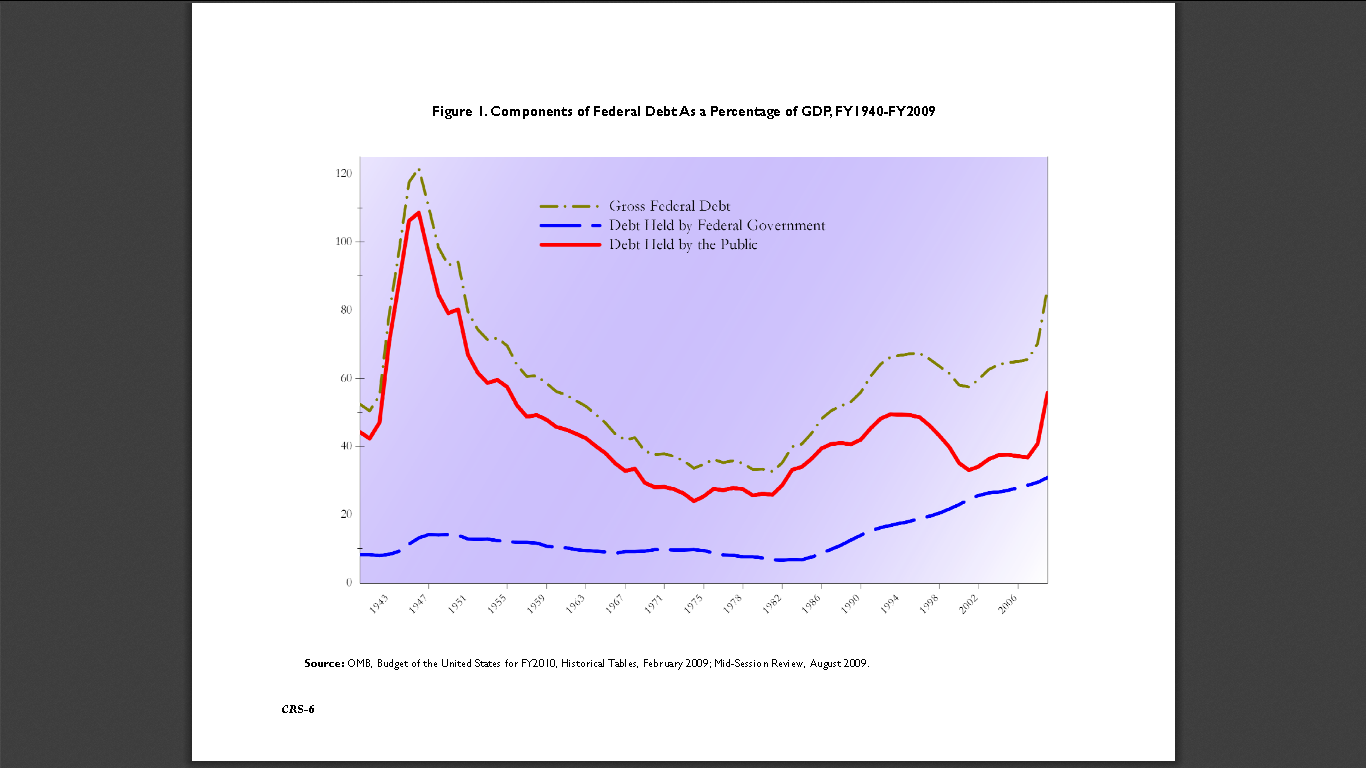
Total debt of the federal government can increase in two ways. First, debt increases when the government sells debt to the public to finance budget deficits and acquire the financial resources needed to meet its obligations. This increases debt held by the public. Second, debt increases when the federal government issues debt to certain government accounts, such as the Social Security, Medicare, and Transportation trust funds, in exchange for their reported surpluses. This increases debt held by government accounts. The sum of
debt held by the public and debt held by government accounts is the total federal debt. Surpluses generally reduce debt held by the public,while deficits raise it. 


The Debt Ceiling in the Last Decade

During the four years (FY1998-FY2001) the government ran surpluses, federal debt held by intergovernmental accounts grew by $855 billion and debt held by the public fell by almost $450 billion. Since FY2001, however, debt held by the public has grown due to persistent and substantial budget deficits. Debt held in government accounts also has grown, in large part because Social Security payroll taxes have exceeded payments of beneficiaries. Table 1 shows components of debt in current dollars and as percentages of gross domestic product (GDP).

Table 1. Components of Debt Subject to Limit, FY1996-FY2009
(in billions of current dollars and as percentage of GDP) 
To see the entire report click this link: http://assets.opencrs.com/rpts/RL31967_20100128.pdf
 

Components of Federal Debt As a Percentage of GDP, FY1940-FY2000

Figure 1. Components of Federal Debt As a Percentage of GDP, FY1940-FY2009

The report then explains how debt limit issues from 2002-2007.  The table below shows increases in the debt limit since 2000.

Table 2. Increases in the Debt Limit Since January 2000

Concluding Comments

Since the late 1950s, the federal government increased its borrowing from the public in all years,
except in FY1969 following imposition of a war surcharge and in the period FY1997-FY2001.
The persistence of federal budget deficits has required the government to issue more and more
debt to the public. The accumulation of Social Security and other trust funds, particularly after
1983 when recommendations of the Greenspan Commission were implemented, led to sustained
growth in government-held debt subject to limit. The growth in federal debt held by the public
and in intergovernmental accounts, such as trust funds, has periodically obliged Congress to raise
the debt limit. Between August 1997, when the debt limit was raised to $5,950 billion, and the beginning of
FY2002 in October 2001, federal budget surpluses reduced debt held by the public. From the end
of FY2001, the last fiscal year with a surplus, until the end of FY2008, debt held by the public
subject to limit grew by $2,484 billion. Federal debt held in intergovernmental accounts grew
steadily throughout the period, rising by $1,743 billion since the beginning of FY 2002

The Bottom Line:

Raising the Debt Ceiling Should Not Be a Bargaining Chip and Held Hostage in Lieu of a Government Shutdown

The Republican controlled House of Representatives has now voted on bills to send to the Senate that include delaying the Affordable Care Act for one year, which President Obama has already said he would allow.

Senate Democratic leadership said they will not accept this language, pushing the federal government a step closer to a government shutdown on Oct. 1. The vote was 231-192 with 2 Republicans voting against and 2 Democrats voting for the measure.

Shutting down the government is not the answer, and most Republicans know that this will hurt their party but the extremist Tea Party members have tunnel-vision and simply, don't care. Contact your Congressmen and Senators and tell them to work it out. Raising the debt ceiling does NOT give authority to spend more money, it only allows America to pay the bills it has already accrued.


To find and contact your Senators use this link: http://www.senate.gov/general/contact_information/senators_cfm.cfm


To find and contact your Congressmen use this link: http://www.house.gov/representatives/

Do it now. Send an e-mail or make a call. People can get things done when they come together and make contact with their representatives.


Saturday, September 28, 2013

The Tea Party and the Koch Brothers could Totally Destroy Democracy if the U.S. Supreme Court gets this Wrong


Photo by obraq.org

McCutcheon v. Federal Election Commission

is to be heard by the Supreme Court Oct. 8th

 
Non-existent is how I would describe House Speaker John Boehner's leadership. Not totally his fault. The Republican Party is being highjacked by about 45 Tea Party members who don't allow the word "compromise" into their vocabulary. They are obstructionists that act like children and have no morals and do not care what anyone wants except for the most rich, greedy, uncaring people, in this world, much less the country.  People that will not accept anything but 100% of what they want or they have temper tantrums. They are motivating people like Sen. Ted Cruz (R-TX), and others by threatening to spend money to defeat them in primary elections if they don't do exactly as the Tea Party wants, and more. Anyone who doesn't please them are enemies as shown when a VP, Andy Roth, of Club for Growth, a right-wing organization, said that "Sen. Bob Corker became a Democrat on the floor of the Senate today." The Tea Party is funded by the likes of the Koch brothers, and PACs like Karl Rove's Crossroads, and Freedomworks. If other house Republicans would stand up to them instead of worrying that they will face a primary challenge from the Tea Party, the Republican Party, would be better off and the legislature might actually be able to get something done. That all leads us to the real problem we face in America. Money in politics.
 
Sen. Elizabeth Warren (D-Mass.,) On Thursday, speaking at an event held by the Constitutional Accountability Center, argued, "If the court continues in the direction of Citizens United, we may move another step closer to neutering Congress' ability to limit the influence of money in politics and another step closer to unlimited corporate contributions given directly to candidates and political committees." She was speaking about McCutcheon v. Federal Election Commission .

True democracy is impossible when you allow unlimited contributions from anonymous donors. Not only can the Koch brothers and others sway elections, but, think of it, you can actually have foreigners pouring crazy amounts of money into our elections. That is just nuts! Let's repeal Citizens United, at least not make it even worse!

In a HuffPost article:  http://www.huffingtonpost.com/2013/09/26/elizabeth-warren-supreme-court_n_3997916.html   The case; McCutcheon v. Federal Election Commission, set to be argued on Oct. 8 was outlined. It challenges the aggregate limit on campaign contributions that an individual donor can make in a single election. Currently, a donor may only give $123,300 in total, made up of sub-limits of $48,600 to candidates and $74,600 to party committees and PACs.

The plaintiff, Alabama businessman Shaun McCutcheon, hopes that the court will eliminate these limits, arguing earlier this year that the issue is "a very important First Amendment case about freedom of speech."
On Thursday, speaking at an event held by the Constitutional Accountability Center, Warren argued, "If the court continues in the direction of Citizens United, we may move another step closer to neutering Congress' ability to limit the influence of money in politics and another step closer to unlimited corporate contributions given directly to candidates and political committees."

Warren also endorsed the research of her former academic colleague, Harvard Law School professor Lawrence Lessig, on the framers of the Constitution's original definition of corruption and on the ways in which Congress has become warped by monied interests.

Lessig, who followed Warren on Thursday, September 26, 2013, with a presentation on his research, sought to frame the McCutcheon case, and the money-in-politics issue generally, in terms the conservative justices on the Supreme Court would respond to. Lessig and the Constitutional Accountability Center have filed an amicus brief in the McCutcheon case based on his research and arguments.

The Supreme Court -- most dramatically in the 2010 Citizens United decision -- has stated that the only type of corruption able to be regulated is quid pro quo, cash-for-votes corruption. But, according to Lessig, this is not the way the framers understood corruption and, thus, neither should the five conservative justices on the court.

Two chapters from the Federalist Papers are of particular interest to Lessig. In Federalist 52, James Madison writes that the federal government created by the Constitution should have at least one branch "dependent upon the people alone." In Federalist 57, Madison writes that the people on whom that branch depends should be "not the rich, more than the poor."
Lessig argued that the oversized reliance of members of Congress on their campaign donors is an institutional corruption of the dependence that Congress is supposed to have "upon the people alone." The foundation for his argument is a number of statements and writings by the framers concerning corruption of this nature -- evidence a constitutional originalist would take into consideration.

Lessig said he had found at least 325 specific instances in which the framers used the term corruption (collected here in a Tumblr blog). Of those, only six explained corruption as a trading of favors, while there were 29 mentions of corruption as an "improper dependence." He also found that 57 percent of the mentions of corruption were about institutions, rather than individuals.
This argument is designed to paint into a corner the five conservative justices, who commonly favor eliminating campaign finance limits, by suggesting that their efforts conflict with the original intent of the framers.
In the McCutcheon case, he argued, the elimination of campaign contribution limits would likely reduce the overall number of donors to campaigns and, thus, make Congress even more dependent upon an even smaller slice of donors, who are not representative of the people. Lessig used research done by National Institute of Money in State Politics executive director Ed Bender that shows that contribution limits expand the number of donors while the elimination of contribution limits reduces the number of donors.
"If you eliminate the cap on aggregate contributions, the number of funders in the system will fall even more than it has so far," Lessig said. "And if the number of funders drop, then the dependence corruption within the system, as I've just described it, only gets worse."

But Lessig said he is optimistic that the justices will look at the McCutcheon case and the original definition of corruption used by the framers and form a strong majority to uphold the aggregate campaign contribution limits.

Contact YOUR SENATORS, use this link to find who they are and how to call and e-mail them.
http://www.senate.gov/general/contact_information/senators_cfm.cfm

Contact YOUR CONGRESSMEN, use this link to find who they are and how to call and e-mail them.
 http://www.house.gov/representatives/


What is Citizens United? | An Introduction

 An article by Reclaim Democracy explains what Citizens United is; http://reclaimdemocracy.org/who-are-citizens-united/

What is Citizens United? The short answer is it’s two different but related things: a Political Action Committee (PAC) in Washington, D.C., and a Supreme Court case about election spending in which the aforementioned PAC was the plaintiff. Both lie at the center of a debate over the role corporations play in society. Read on for the long answer.


It’s a Political Action Committee

The logo for the non-profit group Citizens United
Citizen's United Logo
Citizens United, the PAC, was founded in 1988 by Floyd Brown, a longtime Washington political consultant, with major funding from the Koch brothers (industrialists who own “the second largest privately owned company in the United States”). The group promotes corporate interests, socially conservative causes and candidates who advance their goals, which it says are “…limited government, freedom of enterprise, strong families, and national sovereignty and security.” It gained fame in 2009 for suing the Federal Election Commission, leading to a controversial Supreme Court case (now also commonly known as Citizens United) eliminating some restrictions on how corporations can spend money in elections.


It’s a Supreme Court Case

In the 2008 election season, Citizens United the PAC sought to broadcast TV ads for a video-on-demand film criticizing presidential candidate Hilary Rodham Clinton, but doing so would violate the 2002 Bipartisan Campaign Reform Act (known also as the McCain–Feingold Act), which barred corporations and unions from paying for media that mentioned any candidate in periods immediately preceding elections.
Citizens United challenged the law, suing the Federal Election Commission (which sets campaign finance laws and election rules), and the case made its way through lower courts until an appeal was granted by the U.S. Supreme Court.

If we don't want the 1% to gain even more power and influence over our government and our lives, we must tell our elected politicians that if they don't stand up to the group of well-backed group of greedy, selfish, right-wing extremists, that they won't have to worry about being primaried by the Tea Party because WE WILL FIRE THEM in the next election.

Don't let them hold the full faith and credit of this country hostage. Raising the debt ceiling is not giving permission to spend more money, it's simply allowing us to pay the bills we've already racked up. Look at what happened with the last two times we had a government shutdown!

Here is contact information of The U. S. Supreme Court :
http://www.supremecourt.gov/contact/contactus.aspx

Contact YOUR SENATORS, use this link to find who they are and how to call and e-mail them.
http://www.senate.gov/general/contact_information/senators_cfm.cfm

Contact YOUR CONGRESSMEN, use this link to find who they are and how to call and e-mail them.
 http://www.house.gov/representatives/

Friday, September 27, 2013

Now Republican's Have Canadian Prime Minister Stephen Harper Saying He Won't take No for an Answer on the Keystone XL Pipeline

As to the Keystone XL Pipeline "I will not take NO for an answer"

  Canadian Prime Minister says:

 "I Won't Take No for an Answer"


Who the hell does Canadian Prime Minister Stephen Harper think he is? This is the attitude made possible by the arrogant oil and gas industry profit makers. Those pushing for the Keystone XL Pipeline are so sure their money will get this pipeline approved that they have leaders of foreign countries talking like they don't care what our president or the American people want.

Harper said it will create 40,000 jobs in the U.S., this is a lie, Although it may create 2,500 temporary construction jobs for about two years it will ultimately provide no more than 50-100 permanent jobs once operational.

From an Omaha.com article Rep. Lee Terry (R-OM) on the House Energy and Commerce Committee wanted a sit down with President Obama back on August 1, 2013 because he was concerned that comments made by the White House may  indicate the president is poised to kill the politically charged project.

In a letter to the President he said “Your recent comments have only added to the immense amount of uncertainty that currently surrounds the Keystone XL approval process, unnecessarily jeopardizing $7 billion in private investment.”

The pipeline would transport more than 800,000 barrels of oil a day from Canada to Gulf Coast refineries. But what is not talked about is that none of that oil will be used in the U.S. It will be shipped to China and other foreign nations. The pipeline is owned by Shell and a Saudi Arabian company.

“Republicans have said that this would be a big jobs generator,” Obama said in an interview with the New York Times. “There is no evidence that that's true. The most realistic estimates are this might create maybe 2,000 jobs during the construction of the pipeline, which might take a year or two, and then after that we're talking about somewhere between 50 and 100 jobs in an economy of 150 million working people.”

 “They keep on talking about this — an oil pipeline coming down from Canada that's estimated to create about 50 permanent jobs — that's not a jobs plan,” Obama said.

 “Including direct, indirect, and induced effects, the proposed project would potentially support approximately 42,100 average annual jobs across the United States over a 1- to 2- year construction period (of which, approximately 3,900 would be directly employed in construction activities),” a State Department report said.

 “Operation of the proposed project would generate 35 permanent and 15 temporary jobs, primarily for routine inspections, maintenance, and repairs,” the report said. “Based on this estimate, routine operation of the proposed pipeline would have negligible socioeconomic impacts.” http://www.omaha.com/article/20130801/NEWS/130809925/1685#lee-terry-to-president-obama-let-s-talk-about-keystone
 
Getty Images in HuffPost Politics Article

Keystone XL Pipeline Will Raise Gasoline Prices, Not Just Environmental Concerns

HuffPost Politics September 28, 2013: The last thing Americans, or the American economy needs, is another jump at the gas pump. A new report by Consumer Watchdog finds that's what America will get if the president approves Keystone XL pipeline: a 25 cent to 40 cent gas price hike in the Midwest, and pain at the pump all the way to California.

Relatively cheap Canadian tar sands crude, which is more than half of the crude oil used in Midwest refineries, and increasingly the source of Western refiners, will get a lot more expensive if the XL pipeline developers have their ways. Their articulated goal for the global market: raising the price per barrel of Canadian tar sand oil by $30, from $70 now charged to the $100 per barrel now commanded by Mexican Maya crude oil in the Gulf.

Current events also put into question the alternatives to Keystone XL for anything other than an export pipeline. The Quebec crude oil train disaster on July 6 (50 dead, tremendous destruction) has strengthened opponents of rail transport, sharpening focus on Keystone XL. If pressure will mount against the tar sands crude being transported via rail to the Canadian coast for export, and if there will be no pipeline through West Canada, then the Keystone XL is the main line to markets in Asia and Europe for the cheap tar sands crude. That means Americans will bear the risk of the pipeline and not see any reward. Why would the President of the United States of America want that?

So, all for Shell and a Saudi Arabian company to make billions of dollars Americans are to take the environmental risks, and pay 25 to 40 cents more for gasoline we now have the Canadian Prime Minister saying he won't take no for an answer? Who the hell does he, and the likes of Shell, the Koch brothers and a Saudi Arabian company think they are disrespecting the President of the United States?

It's time to contact your Senators and Congressmen and tell them ENOUGH! Kill the Keystone XL Pipeline and all the lies about it. Tell the Canadian Prime Minister Stephen Harper that if America says NO, it's NO!

To contact your Senators use this link: http://www.senate.gov/general/contact_information/senators_cfm.cfm

To contact your Congressmen use this link:  http://www.house.gov/representatives/find/

Thursday, August 22, 2013

Democratic Push for Reform in All Fifty States...

Democratic Push for Reform in All Fifty States Has GOP Frothing at the Mouth

  by Deborah Montesano of Addicting Info, August 22, 2013

An issue we should all be motivated to get involved in is voter suppression, disenfranchising voters, and the hijacking of the democratic process. Addicting Info's Deborah Montesano wrote "The GOP may have out-foxed itself on the voting rights issue," and we should jump on it!  With the Republican party fractured and able to do nothing but obstruct, they have a problem. Remember the "autopsy" by Chairman Reince  Priebus after the 2012 election that said that the party's main problem was how they were reaching out to, and communicating with, people?  He said they must widen their base and learn how to communicate better with certain demographics. . He said they had an initiative and would spend millions of dollars to go into communities to better communicate with people. How's that working out Reince?What with all the infighting in the party on immigration and a plethora of other issues, they seem to not be doing well with their goals.

So, what to do. It's possible they had this discussion: Ah! we did successfully steal a presidential election, or two, what say we go that route? We could try to fix the vote! Let's enact voting rights legislation that will disenfranchise voters, block others and we could even go absolutely crazy like they are now doing in North Carolina! http://medic3569.blogspot.com/2013/08/republican-voter-suppression-must-be.html

Last week, a 50-state initiative was rolled out by a new nonprofit organization run by Michael Sargeant, the executive director of the Democratic Legislative Campaign Committee. The group takes back language co-opted by conservatives, naming itself American Values First. The intent of the group is to push voting reforms that will make it a whole lot easier for all who are eligible to vote.

Read the full article here http://www.addictinginfo.org/2013/08/21/democrats-take-charge-push-in-50-states-for-voting-reforms/ and then let's GET INVOLVED FOR A BETTER AMERICA!


Tuesday, August 20, 2013

Is the Keystone XL Pipeline Really Needed?

Is the Keystone XL Pipeline Really Needed?

I read many articles that show production and even exports of crude oil is up in the U.S. U.S. oil production reached 7.5 million barrels a day in July, the highest monthly output level since 1991, according to a new government report, the San Antonio's Home Page newspaper reported. According to Census bureau export data reviewed by the Financial Times, the value of petroleum and coal exports more than doubled. There are claims of a high number of jobs that would be created but a State Department report shows that although about 42,000 jobs might be possible over a 1-2 year period that the Keystone would generate only 35 permanent and 15 temporary jobs. “Based on this estimate, routine operation of the proposed pipeline would have negligible socioeconomic impacts.”

U.S. Oil Production and Exports are Up

In an expert commentary August 20, 2013 Fadel Gheit Oil & Gas Senior Analyst at Oppenheimer & Co. by Dukascopy Bank Team | Dukascopy Bank SA Fadel was asked:
 
U.S. oil production reached 7.5 million barrels a day in July, the highest monthly output level since 1991. Do you see the lawmakers removing the limits on crude exports in the future?
He responded "It is difficult to predict what Washington will do, but high oil prices should continue to boost domestic production. However, the US is still importing more than 50% of its oil consumption. There is a ban on crude oil export from the US, but light sweet crude production has exceeded domestic demand levels and the industry is calling on Congress to allow swapping light sweet crude for heavy sour crude, which would benefit both oil producers and petroleum refiners in the US."

Also on August 20, 2013 the MySA, San Antonio's Home Page newspaper reported "U.S. refineries such as Valero's in Three Rivers pushed domestic oil production to 7.5 million barrels a day in July, the highest monthly output in 22 years, and the U.S. Energy Information Administration says production could exceed imports by October."
  • U.S. oil production reached 7.5 million barrels a day in July, the highest monthly output level since 1991, according to a new government report.
  • In its Short-Term Energy Outlook, the U.S. Energy Information Administration also said U.S. production could exceed imports by October for the first time since early 1995.
  • The agency projected that production for the full year will average 7.4 million barrels a day, rising to daily output of 8.2 million barrels in 2014.
On August 19, 2013 on this blog in a post titled "US Fuel Exports Emerging as Driving Force in Obama's Goal of Doubling Exports by 2015" A lead story by James Politi in the US and UK editions of the Financial Times says "The value of US fuel exports has grown faster than other goods and commodities during Barack Obama’s presidency, according to a Financial Times analysis," and that it is emerging as a driving force behind his goal to double exports by 2015. http://www.ft.com/cms/s/0/0db6b1ca-081e-11e3-badc-00144feabdc0.html#ixzz2cQ8ZAHOG